

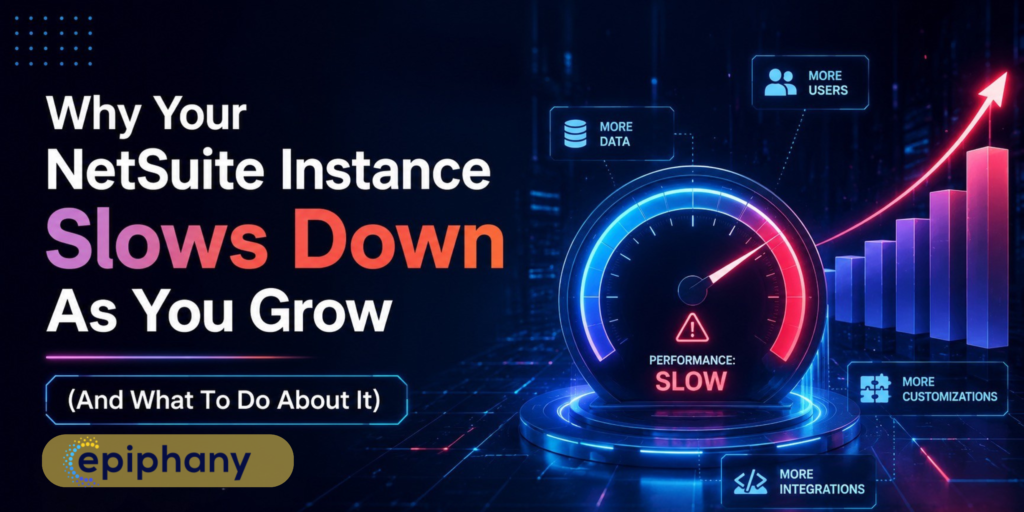
If you have ever sat through a NetSuite page load that felt longer than your coffee break, you are not imagining it. Growth has a funny way of exposing every shortcut, every quick fix, and every “we will deal with that later” decision a company made along the way. In this article, we will talk about why NetSuite instances tend to slow down as MRO companies scale, what is actually happening behind the scenes when that happens, and what you can do about it before it becomes a bigger headache. We will also touch on how a partner like Epiphany, which builds purpose built add on functionality for NetSuite specifically for MRO industries like aviation, heavy equipment, oil and gas, and medical, can help you stay ahead of the curve instead of constantly playing catch up. Let’s get into it.
What Is Actually Happening When NetSuite Slows Down
At its core, NetSuite is built to scale. It is a cloud ERP platform trusted by a huge share of fast growing companies, and for good reason. But scaling smoothly is not automatic. It depends heavily on how the system was set up in the first place and how it has been maintained since. Industry data backs this up clearly: technical debt represents 20 to 40 percent of technology estate value, which makes ERP modernization critical for SaaS and other fast growing companies. That number gets real once you are managing multiple entities, more transaction volume, and a growing list of integrations.
When a company first sets up NetSuite, the configuration usually fits the business perfectly. The trouble starts later, after dozens of small customizations, scripts, and workflows get layered on top of each other over the years. None of these changes seem like a big deal on their own. But NetSuite’s strengths around quick enablement and extensibility also set the stage for growing maintenance burdens if those changes are not carefully managed over time. It is less about one bad decision and more about a hundred small ones stacking up.
This is exactly the kind of challenge Epiphany was built to solve. Since the company works exclusively within the NetSuite ecosystem and focuses on MRO industries, the team understands how operational complexity in aviation, heavy equipment, oil and gas, and medical environments tends to show up inside the system over time.
The Layered Customization Problem
Every business adds customizations as it grows, and that is healthy. The issue is that most companies never go back and clean up the layers underneath. A workflow built for fifty transactions a day behaves very differently once that number hits five thousand. Scripts that were never meant to run at scale start competing for the same resources, and small inefficiencies that used to be invisible suddenly become very visible.
Think about how this plays out in a typical MRO setting. A maintenance team starts out tracking work orders with one simple custom field. A year later, someone adds a script to auto populate that field based on equipment type. Another year goes by and a different team adds a workflow that triggers off that same field for approval routing. None of these additions were wrong when they were made. But now you have three separate pieces of logic depending on each other, built by different people, at different times, often without much documentation connecting them. Multiply that pattern across dozens of fields and processes, and you start to see why performance issues sneak up on companies rather than arriving all at once.
The Multi Entity and Multi Currency Strain
As MRO companies expand into new regions, acquire other businesses, or simply add more subsidiaries, NetSuite has to do a lot more work behind the scenes. Companies scaling from smaller revenue tiers to much larger ones often discover that systems which worked fine at an earlier stage of growth start to strain under multi-country complexity and tightening compliance requirements. Multi entity consolidation, currency conversion, and intercompany transactions all add computational weight, especially if the underlying setup was never designed with that scale in mind.
This shows up most clearly during financial close. A consolidation process that used to take an afternoon can stretch into days once a few new subsidiaries are added to the mix, particularly if intercompany eliminations and currency revaluations were configured manually rather than built to handle additional entities smoothly. For MRO companies operating across borders, whether that means servicing aircraft fleets in multiple countries or managing equipment rental locations across regions, this strain tends to show up earlier than leadership expects.
The Integration Sprawl Issue
Most growing companies do not run NetSuite in isolation. They connect it to CRMs, field service tools, inventory systems, and a dozen other platforms. Each new integration is useful on its own, but together they can create what some experts call integration sprawl. Data flows in and out from multiple directions, and if those connections were not designed to work well together, NetSuite ends up doing extra work just to keep everything in sync.
For MRO businesses specifically, this often means juggling connections between NetSuite and field service management tools, equipment tracking systems, and parts inventory platforms all at once. Each one might be perfectly efficient on its own. But if they were bolted on over time rather than planned together, NetSuite can end up processing redundant data or running sync jobs more frequently than necessary, which quietly eats into system performance.
The Real Cost of Letting This Build Up
It is tempting to treat a slower NetSuite instance as a minor annoyance. Click, wait, click, wait. But the cost adds up in ways that are easy to underestimate. Slower processing means more time spent per transaction. More time per transaction means higher labor costs for the exact same output. And in MRO industries specifically, where technicians and operations teams rely on NetSuite for everything from work orders to parts tracking, delays in the system translate directly into delays on the shop floor.
This is not just a NetSuite issue either. Across manufacturing more broadly, scaling production without the right technology and equipment in place is one of the toughest challenges companies face, and ERP systems that centralize data properly are a key part of solving it. The same logic applies whether you are managing aircraft components, heavy equipment fleets, or medical device inventory.
Hidden Costs Versus Visible Costs
When companies budget for NetSuite, they usually account for the visible costs: subscription fees, implementation costs, and the initial customization work. What often gets missed are the hidden costs that show up after going live. These hidden costs are downstream expenses that arise once a system is in production, and they are typically the direct result of accumulated technical debt. They are real, they are ongoing, and they rarely show up on a single invoice where someone might notice them.
The tricky part about hidden costs is that they tend to get absorbed into normal operations rather than flagged as a problem. A technician who spends an extra fifteen minutes per work order working around a clunky custom field does not file a complaint about it. A finance analyst who manually adjusts a report every month because the automated version pulls outdated data just builds that adjustment into their routine. None of it looks like an emergency. It just slowly becomes the new normal, until someone adds up the hours and realizes how much it actually costs.
The Compounding Effect On Reporting
A slower system does not just affect day to day transactions. It also affects how quickly leadership can get accurate, real time visibility into the business. Common triggers companies run into include poor reporting, manual month end processes, and limited scalability, which create increasing pressure from investors, auditors, and boards. If your finance team is still waiting on reports two weeks after month end, that is often a symptom of the same underlying issue.
For MRO companies, this is more than a finance team headache. Reporting delays mean operations leaders are making decisions about parts ordering, technician scheduling, and equipment allocation based on information that is already a little out of date. In industries where downtime is expensive and parts availability is critical, even a few days of lag in reporting accuracy can mean the difference between catching a problem early and discovering it after it has already affected a customer.
The Opportunity Cost Nobody Talks About
Every hour spent troubleshooting a slow system or working around a clunky customization is an hour not spent on something that actually grows the business. This is the cost that rarely makes it into a spreadsheet, but it is often the biggest one. Companies that get ahead of this tend to free up real capacity for their teams instead of spending it on maintenance.
It is worth asking what your best people would be doing if they were not spending part of their week managing workarounds. Maybe your operations lead would be building out a new service line instead of chasing down why a report does not match the numbers in another system. Maybe your IT team would be exploring automation opportunities instead of patching the same script for the third time this year. The opportunity cost is invisible precisely because the alternative never gets a chance to happen.
What Smart MRO Companies Are Doing About It
The good news is that none of this is inevitable. Companies that treat their NetSuite environment as something to actively manage, rather than something to set up once and forget about, tend to avoid most of these problems entirely. The shift happening across the industry in 2026 is toward modern development approaches that support growth without creating technical debt, keeping systems scalable, adaptable, and easier to manage over time.
This is where having a NetSuite partner who actually understands your industry makes a real difference. Epiphany has spent years building purpose-built add-on functionality specifically for MRO companies, which means the team is not starting from a generic playbook. They are working from real experience with the operational patterns that show up in aviation, heavy equipment, oil and gas, and medical environments.
Governance Over Guesswork
Customizing NetSuite should speed up work, not add risk, and the companies that get this right tend to follow a clear governance framework rather than letting customizations pile up organically. That means documenting changes, assigning ownership, and reviewing the system periodically instead of only touching it when something breaks.
A simple governance habit can go a long way. Something as basic as keeping a running log of who built each customization, why it was built, and what it depends on can save dozens of hours down the line when it is time to troubleshoot or upgrade. Companies that skip this step are not being careless on purpose. It is just easy to deprioritize documentation when everyone is focused on getting the next feature live. The cost of that shortcut usually shows up two or three years later, often right around the time a company starts scaling fast enough that the lack of documentation actually matters.
Designing For The Next Stage, Not Just The Current One
The smartest NetSuite environments are built with room to grow. Rather than solving only for today’s transaction volume, the goal is to design workflows and customizations that can comfortably handle what the business will look like in two or three years. This is exactly the kind of forward thinking Epiphany brings to client engagements, since the team works across MRO businesses at very different stages of growth and has seen what holds up over time.
This forward looking approach matters most in industries like aviation and heavy equipment, where Epiphany has spent years building purpose built add on functionality tailored to the specific operational patterns these businesses run into. A company managing a fleet of ten pieces of equipment has very different needs than one managing a thousand, and the customizations that work well at one scale can become a liability at another if nobody planned ahead for that transition.
Bringing In AI Ready Foundations
As more MRO companies start exploring AI for things like predictive maintenance and parts forecasting, a clean and well organized NetSuite environment becomes even more valuable. AI powered approaches to inventory and operations planning are reshaping how companies maintain parts availability and control working capital, but they depend on having reliable, well structured data to work from. Epiphany’s AI Compass Assessment is built specifically to help companies understand where they stand on this front, long before they invest in bigger AI initiatives.
This is one of the more overlooked benefits of keeping a NetSuite environment well maintained. Companies that have already done the work of cleaning up their customizations and consolidating their data tend to have a much easier time adopting AI tools later, simply because the foundation is already there. Trying to layer predictive analytics or automation on top of a messy, undocumented system tends to surface the same underlying issues all over again, just with higher stakes attached.
How To Know If It Is Time For A Closer Look
You do not need a major outage to justify a NetSuite health check. Some of the clearest signals are the quiet ones. Reports that used to take a day now take a week. New employees needing extra training just to work around old quirks in the system. A simple change request that somehow turns into a three week project. None of these are dramatic on their own, but together they tell a pretty clear story.
Another good signal is how your team talks about the system. If phrases like “we just do it this way because that is how it has always worked” or “nobody really knows why that script runs” come up often, that is usually a sign that institutional knowledge has outpaced documentation. The people who built the original customizations may have moved on, leaving behind processes that work but that nobody fully understands anymore. That is not a crisis yet, but it is exactly the kind of situation that turns into one eventually.
The companies that come out ahead are the ones who treat this as routine maintenance rather than an emergency response. A NetSuite environment that gets periodic attention rarely turns into the kind of problem that requires a full overhaul. This is also where bringing in a specialized partner pays off, since someone who works inside MRO focused NetSuite environments every day can usually spot patterns faster than an internal team that only deals with the system occasionally.
Wrapping It Up
At the end of the day, a NetSuite instance slowing down is not a sign that something has gone wrong. It is usually just a sign that your business has outgrown the version of the system you built a few years ago, which is a pretty good problem to have if you think about it. The companies that handle this well are not the ones who avoided growth pains entirely. They are the ones who paid attention early and brought in the right expertise before small inefficiencies turned into expensive ones. If your NetSuite instance has been feeling a little less snappy lately, consider it less of an alarm bell and more of an invitation to grow into a system that finally fits. And on that note, we will go ahead and let your NetSuite instance take a well deserved breather while you go figure out its next upgrade.
Sources
- https://www.vnmtsolutions.com/netsuite-customization-guide/
- https://www.novutech.com/news/why-netsuite-in-2026-why-your-implementation-partner-matters-more-than-ever
- https://www.bairesdev.com/blog/netsuite-customization/
- https://www.henleymorgan.com/blog/2026/02/why-netsuite-is-no-longer-optional-for-scaling-businesses-in-2026
- https://www.houseblend.io/articles/netsuite-customization-costs
- https://www.anchorgroup.tech/blog/netsuite-implementation-guide-software-saas
- https://www.houseblend.io/articles/netsuite-manufacturing-routing-work-orders-mrp
- https://www.netsuite.com/portal/resource/articles/erp/manufacturing-scalability.shtml
- https://throughput.world/blog/spare-parts-and-mro-inventory-optimization/
- https://www.capgemini.com/us-en/insights/expert-perspectives/mro-at-a-crossroads-embracing-digital-technology-to-overcome-industry-challenges/