

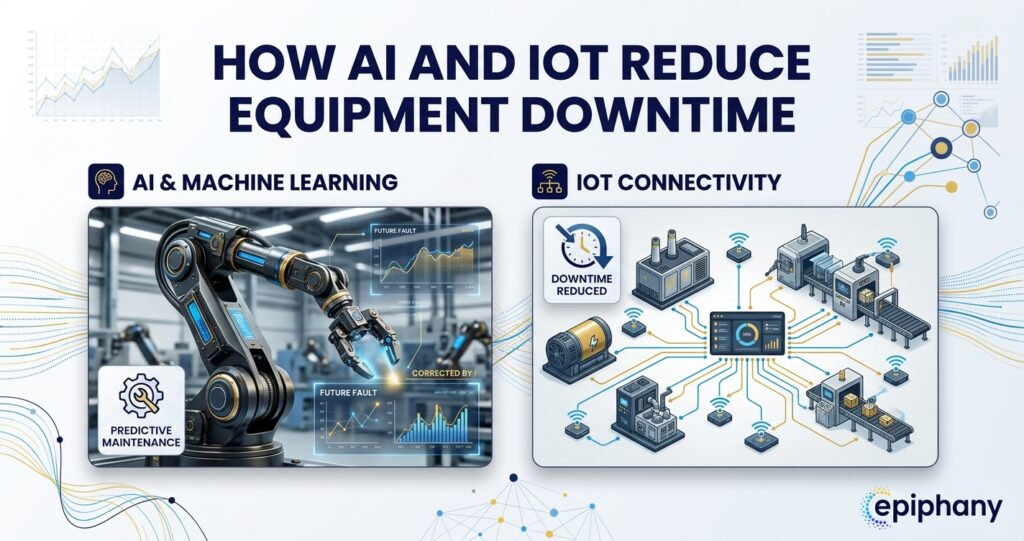
Equipment downtime is one of those problems that rarely stays contained. A machine stops working, and suddenly a technician is searching for the cause, a replacement part needs to be located, production schedules have to change, customers may be waiting, and managers are trying to understand how long the disruption will last. For MRO teams, the frustrating part is that many equipment failures do not happen completely without warning.
Changes in temperature, vibration, pressure, operating conditions, or performance can sometimes appear before a serious failure occurs. The challenge is recognizing those signals early enough to do something about them. This is where the combination of Artificial Intelligence and the Internet of Things becomes particularly useful.
In this article, we’ll look at how AI and IoT reduce equipment downtime, how connected equipment can reveal problems before they become failures, how AI turns equipment data into maintenance decisions, and why connecting those insights to actual MRO workflows is what ultimately makes the difference.
Why Equipment Downtime Is Still Such a Difficult Problem
Reducing downtime sounds simple in theory. Keep equipment maintained, fix problems quickly, and prevent failures whenever possible. In practice, maintenance teams are dealing with thousands of variables at once, and equipment does not always follow a predictable schedule.
Equipment Does Not Always Fail According to a Maintenance Calendar
Traditional preventive maintenance has helped organizations avoid many unexpected failures by servicing equipment at predetermined intervals. A machine might be inspected every six months, a component might be replaced after a certain number of operating hours, or a manufacturer might recommend a specific maintenance schedule.
The problem is that a calendar does not know what the equipment has actually experienced since the last service.
Two identical machines can operate under completely different conditions. One may run continuously under heavy loads while another operates intermittently. One may be exposed to heat, dust, vibration, or other demanding conditions while the other operates in a relatively controlled environment. Treating both assets exactly the same can mean performing maintenance too early on one and too late on another.
This is one reason predictive maintenance has become increasingly important. IBM defines predictive maintenance as using operational data and real time condition monitoring to predict when an asset is likely to fail, with IoT sensors and AI or machine learning helping identify changes in operating conditions and performance.
The objective is not to abandon scheduled maintenance completely. It is to add another source of information so maintenance decisions can reflect what is actually happening to the equipment.
Unplanned Downtime Creates More Than a Repair Bill
The cost of downtime is also much larger than the cost of the failed component itself. When equipment stops unexpectedly, the organization may lose production capacity, delay customer orders, pay for emergency labor or expedited shipping, and create additional work for other teams.
Deloitte has estimated the annual cost of unplanned downtime for industrial manufacturers at around $50 billion. Its research also reports that manufacturers using preventive or predictive maintenance have experienced less unplanned downtime, fewer defects, and other operational improvements compared with reactive approaches.
That makes downtime a business problem rather than simply a maintenance problem.
Once an organization sees the wider impact, the value of detecting a problem earlier becomes easier to understand. Preventing a failure before it takes an asset offline can protect production, customer commitments, technician capacity, and inventory at the same time.
IoT Gives Maintenance Teams a Continuous View of Equipment
AI cannot predict equipment problems without information to analyze. This is where IoT becomes the foundation of the process because connected equipment can continuously produce data about its operating condition.
Sensors Turn Physical Equipment Into Data
An IoT enabled machine can use sensors to monitor conditions such as vibration, temperature, pressure, flow, acoustics, energy consumption, or operating hours, depending on the type of equipment involved. Instead of relying entirely on periodic inspections, maintenance teams can receive a much more continuous picture of how an asset is behaving.
Deloitte describes IoT as part of the physical to digital connection that allows equipment data to be streamed into enterprise systems. Its predictive maintenance research specifically identifies sensors, programmable logic controllers, ERP systems, maintenance systems, telematics, and other sources as potential inputs into predictive maintenance models.
That changes the amount of information available to the maintenance team.
A technician performing an inspection might identify a problem at a particular point in time. A connected asset can potentially provide information throughout its operating cycle.
That difference becomes particularly valuable when the early signs of failure are subtle.
Continuous Monitoring Can Catch Changes Earlier
Imagine a piece of rotating equipment that normally operates within a relatively consistent vibration range. Over several weeks, its vibration begins increasing gradually.
A periodic inspection might not catch that change until the next scheduled visit. Continuous monitoring can capture the change as it develops.
The same principle can apply to temperature, pressure, energy consumption, or other measurable conditions. The important information is often not the individual reading but the change from the asset’s normal behavior.
IBM describes predictive maintenance architectures in which sensors capture physical measurements and machine learning models establish an understanding of normal operating signatures. AI can then help identify deviations from those patterns that may indicate developing problems.
That gives maintenance teams something they did not have before.
Time.
And in MRO, time can be the difference between a planned repair and an emergency repair.
AI Turns Equipment Data Into Maintenance Intelligence
IoT can tell an organization what is happening with an asset, but raw data alone does not tell a maintenance team what deserves attention. This is where AI becomes important.
AI Looks for Patterns Humans May Miss
A modern connected asset can generate enormous quantities of information. If an organization has hundreds or thousands of connected assets, manually reviewing every temperature reading, vibration change, operating condition, and maintenance record becomes unrealistic.
AI can analyze much larger volumes of data and look for patterns across equipment histories and operating conditions.
Instead of asking whether one reading looks unusual, an AI system can potentially consider how that reading compares with previous behavior, similar equipment, historical failures, maintenance activity, operating conditions, and other relevant information.
Deloitte describes this as combining sensor data with ERP information, historical maintenance and repair data, production data, and field reports. When those sources are analyzed together, organizations can develop a more complete understanding of equipment behavior and generate maintenance recommendations.
The value comes from context.
A temperature increase on its own may not mean much. A temperature increase combined with a change in vibration and a pattern that previously appeared before a bearing failure may deserve considerably more attention.
AI Can Help Separate Noise From Meaningful Signals
One of the biggest problems with connected equipment is that more data can sometimes create more noise.
If every unusual reading generates an alert, maintenance teams can quickly become overwhelmed. Eventually, alerts start competing with one another, and important warnings can be lost among less important notifications.
AI can help prioritize signals based on patterns and historical information rather than simply reacting to every deviation.
This is important because the goal of predictive maintenance is not to create more alerts.
The goal is to create better decisions.
A useful system should help maintenance teams understand which changes are potentially significant, which assets may require attention, and how urgently they should be investigated.
That is where AI begins to move from monitoring into operational intelligence.
Predictive Maintenance Gives Teams More Time to Act
The biggest advantage of combining IoT monitoring with AI is not necessarily prediction for its own sake. It is the opportunity to move maintenance activity from emergency response toward planned intervention.
Early Warnings Change the Maintenance Decision
Suppose an AI system identifies a pattern suggesting that a component may be approaching failure. The organization now has an opportunity to investigate before the asset actually stops working.
The team may be able to schedule an inspection during an appropriate maintenance window. It may be able to order the replacement component before the existing one fails. It may be able to assign a technician who already has the right skills and experience.
The repair can happen because the organization planned for it rather than because the equipment forced everyone to react.
Deloitte’s research has reported that predictive maintenance can reduce the time required to plan maintenance by 20 to 50 percent and increase equipment uptime and availability by 10 to 20 percent in relevant implementations.
Those numbers are not a universal guarantee for every organization, but they illustrate why predictive maintenance is attracting so much attention.
The value is created by changing the timing and quality of the decision.
Planned Repairs Are Easier to Manage Than Emergency Repairs
An emergency repair tends to create pressure throughout the operation.
A part may need to be sourced immediately. A technician may need to be pulled away from another job. Production may already be affected. Customers may need to be notified. Managers may have to make decisions without complete information.
A planned repair is different.
The organization has more control over the timing, resources, parts, and people involved.
This is one of the strongest arguments for predictive maintenance. It does not necessarily eliminate repairs. Instead, it can help move more repairs into a controlled environment.
For an MRO operation, that distinction can have a major effect on turnaround time and operational stability.
AI and IoT Can Improve Parts Availability
Equipment downtime is often blamed on the failure itself, but the failed component is not always what keeps the equipment offline. Sometimes the real problem is waiting for the replacement part.
That means equipment intelligence needs to connect with inventory intelligence if an organization wants to reduce downtime consistently.
Knowing a Failure Is Coming Can Help With Parts Planning
If an AI system identifies a potential component failure early enough, the maintenance team may have time to check whether the required part is available.
If it is not, procurement can potentially begin sourcing it before the equipment fails.
This is one of the benefits Deloitte identifies in predictive maintenance. Earlier knowledge about replacement requirements can support procurement planning, improve timing and sourcing, and potentially reduce the amount of unnecessary spare equipment held on site.
That creates a much more coordinated maintenance process.
The equipment is telling the organization what may happen next. The AI is helping interpret that information. Inventory and procurement teams can then prepare for the potential requirement.
Parts Data Makes Predictive Maintenance More Actionable
This is where integrated MRO systems become important.
Knowing that a particular component is likely to fail is useful. Knowing that the component is available in a nearby warehouse is better. Knowing that it is not available and has a long supplier lead time is even more important because the maintenance team can make a decision before the failure occurs.
Epiphany‘s eService MRO solution is designed around this broader operational picture, bringing together parts and consumables tracking, preventative maintenance, repairs, inventory, demand forecasting, vendor analytics, equipment history, and technician scheduling inside NetSuite.
The point is not that every prediction automatically prevents downtime.
It is that predictions become much more useful when the surrounding information needed to act on them is available in the same operational environment.
AI Can Reduce the Time It Takes to Diagnose Problems
Preventing every failure is not realistic. Even highly sophisticated maintenance programs will eventually encounter unexpected problems. That makes diagnosis and repair speed just as important as prediction.
Equipment History Can Give Technicians More Context
When equipment fails, technicians need information quickly. What happened previously? Has this asset experienced the same problem before? Which components have already been replaced? What maintenance was performed recently? Is the equipment covered by a warranty or service contract?
If those answers are buried across separate systems, emails, documents, and spreadsheets, diagnosis can take longer.
A connected MRO environment can provide a more complete history around the asset. Epiphany’s eService MRO solution, for example, provides lifecycle tracking that includes maintenance history, warranty status, site level tracking, and preventative care scheduling. It also provides visibility into work orders, repair processes, parts, and equipment configuration.
That information becomes even more valuable when AI can help surface the relevant details instead of forcing technicians to search manually.
Generative AI Can Help With Maintenance Knowledge
AI is also beginning to change how technicians interact with maintenance information.
McKinsey’s research into generative AI and maintenance describes applications that can process existing failure mode and effects analyses, identify failure modes, recommend maintenance actions, and help organizations capture knowledge that might otherwise remain difficult to access.
This matters because maintenance knowledge is often distributed across people and documents. One technician may know that a particular failure tends to occur under a specific operating condition. Another may know the fastest way to diagnose it. A historical work order may contain the exact repair procedure that worked previously.
AI can potentially help bring those pieces together. That can reduce the time between “something is wrong” and “we understand what is wrong.”
AI and IoT Can Help Reduce Repeat Failures
Reducing downtime is not just about fixing the immediate problem. If the same problem keeps happening, the organization may be treating symptoms rather than addressing the underlying cause.
Maintenance History Can Reveal Recurring Patterns
A single equipment failure may look like an isolated incident. Five similar failures across the same asset type may tell a different story.
AI can analyze historical work orders, failure codes, component replacements, operating conditions, and other records to identify recurring patterns.
McKinsey has described generative AI applications that use historical maintenance information to create and update failure mode analyses and connect identified failure modes with maintenance actions. In one example, the organization reported a significant reduction in equipment downtime after implementing an AI based FMEA process. This creates an opportunity to move beyond simply repairing equipment. The organization can begin asking why the equipment keeps failing.
Root Cause Analysis Becomes More Data Driven
If a particular component repeatedly fails after exposure to a certain operating condition, that information can influence future maintenance strategies.
The organization may change the inspection interval. It may change the component specification. It may modify the operating procedure. It may investigate a supplier quality issue. It may redesign part of the equipment.
AI does not replace engineering judgment in this process. Instead, it can make it easier to identify relationships across large amounts of historical information. That is particularly valuable in MRO environments where the same equipment may be operating across multiple locations and generating years of maintenance history.
The Biggest Opportunity Comes From Connecting AI, IoT, and MRO Workflows
It is easy to describe AI and IoT as separate technologies. IoT collects data. AI analyzes data.
But the real operational value appears when the information moves into the workflow where someone can act on it.
An Alert Is Not the Same as a Maintenance Action
Imagine a connected pump sends an abnormal vibration signal. AI analyzes the signal and determines that the pattern resembles previous bearing failures.
That is useful. But the organization still needs to decide what happens next.
Someone may need to review the alert, create a work order, check parts availability, schedule a technician, inspect the pump, and complete the repair. If those steps remain disconnected, the organization has created an intelligent alert without necessarily creating an intelligent maintenance process.
Deloitte’s current work on maintenance transformation emphasizes this gap between technology and execution, highlighting fragmented operational knowledge, data silos, maintenance backlogs, and spare parts challenges as barriers to turning predictive maintenance into measurable business outcomes.
This is where the system surrounding the AI becomes just as important as the AI itself.
Epiphany Connects Intelligence With Operational Processes
Epiphany’s current AI approach emphasizes connecting AI generated insights with actual maintenance and operational workflows. Its AI solutions describe a process in which equipment information can be analyzed for unusual patterns and the resulting insight can contribute to a maintenance review, notification, recommendation, or preventative work order.
That is a practical distinction. The objective is not to put an AI dashboard beside the MRO system.
The objective is to make intelligence useful inside the process the maintenance team is already using. ConnectX fits into this broader idea by connecting operational data, workflows, analytics, and AI capabilities. For an MRO organization, that creates a path between what the equipment is saying, what the AI is identifying, and what the maintenance team actually needs to do.
That is where the physical and digital sides of maintenance begin working as one system.
Better Equipment Visibility Can Improve Maintenance Planning
One of the less obvious benefits of AI and IoT is that they can make maintenance planning more predictable even when no immediate failure is expected.
Maintenance teams are constantly balancing scheduled work, potential problems, technician availability, equipment usage, and parts availability.
Real Time Data Helps Teams See What Is Changing
A maintenance plan created months ago is based on the information available at that time.
Real time equipment information can change that picture. If an asset is operating under heavier conditions than expected, the maintenance team may need to pay closer attention to it. If another asset is operating normally, there may be less urgency around intervention.
Deloitte notes that smart asset management combines data from sensors, maintenance systems, ERP platforms, and other sources to support more timely and data driven maintenance decisions.
This allows maintenance planning to become more dynamic.
Instead of treating the maintenance schedule as a fixed document, teams can use current information to adjust priorities as equipment conditions change.
Technician Scheduling Can Become More Precise
The same principle applies to people. If a potential failure is identified early, the organization can potentially schedule the right technician before the problem becomes urgent.
That is especially useful in specialized MRO environments where not every technician can work on every type of equipment.
Epiphany’s eService MRO capabilities include technician availability by skill set, tools and equipment scheduling, work order prioritization, and real time dashboards for open work orders and status. When those capabilities are connected with better equipment information, maintenance teams can make scheduling decisions with more context.
The result is not simply a smarter maintenance calendar.
It is a maintenance operation that can respond to changing equipment conditions without constantly operating in emergency mode.
AI and IoT Can Help Improve Mean Time Between Failures and Mean Time to Repair
Two measurements are particularly useful when evaluating equipment reliability: Mean Time Between Failures and Mean Time to Repair.
They measure different problems, and AI and IoT can potentially influence both.
Increasing the Time Between Failures
Mean Time Between Failures looks at how long equipment operates before experiencing another failure.
Predictive maintenance can help increase this number by identifying degradation earlier, supporting preventative interventions, and helping teams understand recurring failure patterns.
Deloitte’s work on predictive maintenance describes the goal as maximizing asset life while avoiding unplanned downtime and minimizing unnecessary planned downtime. The organization is not simply trying to repair equipment faster. It is trying to keep the equipment from needing repair in the first place.
Reducing the Time Needed to Repair Equipment
Mean Time to Repair looks at what happens after a failure occurs.
This is where equipment history, documentation, parts availability, technician scheduling, and workflow visibility become important.
If the technician knows what happened previously, has access to the right documentation, has the required part available, and can see the work order clearly, the repair process can move faster.
Deloitte’s smart manufacturing case study with Savola Foods found that its IoT implementation supported reduced breakdown related downtime, improved Mean Time to Repair, and improved Mean Time Between Failures by providing real time data, alerts, digital asset information, and maintenance workflows.
That is an important distinction. AI and IoT do not only have to prevent failures. They can also make the organization better at responding when failures happen.
The Data Foundation Matters More Than the AI Label
There is a temptation to think that once an organization purchases an AI solution, predictive maintenance is essentially solved.
It is not.
The quality of the data, the structure of the asset records, the consistency of maintenance history, and the connection between systems can determine how useful the technology becomes.
AI Needs Reliable Equipment Data
If an organization has incomplete asset records, inconsistent maintenance descriptions, missing failure histories, or disconnected inventory information, the AI has less context to work with.
McKinsey’s research into aftermarket and field service AI highlights the range of information required for advanced AI use cases, including maintenance documentation, troubleshooting information, IoT sensor data, equipment history, supply chain information, parts availability, vendor lead times, and personnel skills and availability.
That list makes something clear. Predictive maintenance is not just a sensor project. It is a data integration project.
Connected Systems Make the Data More Useful
This is one reason Epiphany’s approach focuses heavily on bringing MRO information together.
Its eService MRO platform is built natively on NetSuite and combines asset, parts, inventory, repair, maintenance, warranty, vendor, and technician information within the operational environment.
Epiphany also has PDF Eater, which uses AI to extract structured information from PDFs, spreadsheets, and email attachments and make that information available in ERP ready formats. That may sound separate from equipment downtime, but it is connected to the same underlying problem.
AI needs usable information. The more operational information an organization can structure and connect, the more opportunities it has to use AI effectively.
Reducing Downtime Is About More Than Predicting Failure
It is tempting to define AI driven maintenance as simply predicting when something will break. That is only part of the opportunity.
Downtime Reduction Starts Before the Failure
The first opportunity is prevention. IoT monitors the asset, AI analyzes the information, and the maintenance team receives an early indication that something may require attention.
That creates the possibility of a planned intervention. The organization can inspect the equipment, prepare the part, assign the right technician, and schedule the work before the asset becomes unavailable.
Downtime Reduction Continues During the Repair
The second opportunity is response.
When a failure does happen, the organization can use equipment history, repair records, documentation, inventory information, technician availability, and workflow automation to reduce the time required to diagnose and resolve the problem. This is why downtime should be viewed as a lifecycle problem.
Prevent the failure where possible. Detect it quickly when it begins. Diagnose it efficiently. Have the right resources ready. Complete the repair.
Then learn from what happened.
AI and IoT can contribute at every stage, but they become far more effective when connected to the operational systems managing the asset lifecycle.
Wrapping Up – AI and IoT Make Maintenance More Predictable
AI and IoT are changing the way organizations approach equipment downtime because they allow maintenance teams to see more of what is happening between scheduled inspections and actual failures. IoT provides continuous information from connected equipment, while AI can analyze that information to identify patterns, detect anomalies, prioritize potential problems, and support better maintenance decisions. Research from Deloitte and IBM shows that predictive maintenance can contribute to reductions in downtime, improvements in equipment availability, and more efficient maintenance planning when implemented effectively.
But the biggest opportunity does not come from collecting more sensor data or generating more AI alerts. It comes from connecting those insights to the rest of the MRO operation.
A prediction is useful when the organization can respond to it. That might mean creating a preventative work order, checking whether a replacement part is available, scheduling a qualified technician, reviewing previous repair history, or planning an intervention before equipment failure creates a larger operational problem.
This is where integrated MRO technology becomes increasingly important. Epiphany’s approach brings maintenance, repairs, parts, inventory, equipment history, warranties, technician scheduling, and other operational processes together, while its AI capabilities focus on connecting intelligence with the workflows that maintenance teams already use.
The goal is not to eliminate every equipment failure. That is not realistic.
The goal is to make failures less disruptive, repairs more predictable, and maintenance decisions more informed.
When equipment can communicate what is happening, AI can help interpret what that information means, and the MRO system can help turn that insight into action, maintenance becomes less reactive.
And that can mean fewer surprises, shorter repair cycles, better asset utilization, and less time spent asking why the equipment stopped working when the more useful question could have been answered earlier: what was the equipment trying to tell us?
Sources
- IBM: What Is Predictive Maintenance?
- IBM: The Role of AI in Predictive Maintenance
- Deloitte: Using AI in Predictive Maintenance
- Deloitte: Predictive Maintenance and the Smart Factory
- Deloitte: Predictive Maintenance Infographic
- Deloitte: IoT and the Benefits of Smart Manufacturing
- McKinsey: Rewiring Maintenance With Gen AI
- McKinsey: Scaling Gen AI in Aftermarket and Field Services
- Epiphany: eService MRO
- Epiphany: How AI Solutions Actually Work Without the Buzzwords