

Every year, billions of dollars in MRO service revenue are lost because of one avoidable problem: repair workflows that were never built to handle the complexity of what modern depot operations actually do. Parts go missing between intake and return. Technicians wait on approvals that exist in nobody’s system. Customers call for status updates on jobs that no one can track in real time. Invoices go out late or wrong because billing has no visibility into what happened on the shop floor. For MRO service providers in aviation, aerospace, oil and gas, heavy equipment, and manufacturing, these are not minor inconveniences. They are operational failures that drive up cost, erode customer trust, and eat directly into profitability.
In this article we will talk about Epiphany’s repair management for NetSuite, what Epiphany pre, during, and post implementation actually means for depot repair operations, how it works inside asset-intensive industries, and why companies that deliver maintenance, repair, and operations services to their customers across aviation, aerospace, oil and gas, heavy equipment, and manufacturing are making the move to Epiphany’s repair management solution for NetSuite in 2026.
We will break down the core capabilities of Epiphany’s purpose-built add-on functionality for NetSuite, explore what makes it the right fit for companies managing complex depot repair workflows and spare parts inventory on behalf of their customers, and explain why purpose-built functionality is becoming the deciding factor for MRO service providers that want more than a standard ERP can deliver out of the box.
Understanding Epiphany’s Repair Management Solution for NetSuite
Repair management for MRO service providers is the process of managing the complete lifecycle of a customer repair job, from the moment a broken or degraded asset arrives at the service facility to the moment it is returned to the customer in certified, serviceable condition.
This covers intake processing, diagnosis and estimation, work order creation and assignment, parts procurement and consumption, labor tracking, quality inspection, compliance documentation, and final customer invoicing. When all of these steps live inside a single connected system, the entire service operation becomes faster, more accurate, and far more visible to every stakeholder involved.
NetSuite is one of the world’s leading cloud ERP platforms, and many MRO service companies already use it as their core business system. What NetSuite does not provide out of the box is the depth of repair-specific functionality that customer-facing MRO service operations require. Standard NetSuite work order management was designed for manufacturing and distribution workflows that focus on building things. Epiphany Service Work Order is built for the complexity of inspecting things, taking apart things, replacing specified things, it is not repetitive nor known before the start of the repair. Manufacturing software systems, such as NetSuite, are not built for the complexity of managing repairable customer assets through a structured depot repair process. That is precisely the gap that Epiphany fills. Epiphany develops purpose-built add-on functionality for NetSuite that gives MRO service companies the repair management capabilities their operations actually need, built natively inside the NetSuite environment so everything stays connected in one place.
When MRO service companies search for NetSuite repair management, what they are really looking for is a way to run complex, customer-facing repair operations inside NetSuite without working around its limitations. Epiphany’s repair management solution is the answer to that search. It is not a separate system sitting alongside NetSuite. It is purpose-built functionality living inside NetSuite, extending the platform with the capabilities that make it genuinely fit for MRO service delivery.
What Epiphany Adds to NetSuite for Repair Management
To understand why Epiphany‘s add-on functionality matters, it helps to understand what standard NetSuite cannot do for a depot repair operation. Standard NetSuite was designed to support manufacturing work orders rather than customer facing service work orders. While it can create a manufacturing work order, assign resources, and track production activities, it does not natively support the service work order processes required for complex MRO operations.
It cannot manage the structured intake of customer assets arriving in unknown condition, route repairs through configurable multi stage workflows with approvals and quality checkpoints, track rework when repairs fail inspection, manage regulated parts traceability and compliance documentation, or connect the complete repair process to customer service contracts and repair specific billing.
Epiphany fills these gaps by introducing purpose built service work order functionality within NetSuite, giving MRO service providers the tools they need to manage the entire repair lifecycle from asset receipt through invoicing in a single connected environment.
Epiphany’s purpose-built repair management functionality for NetSuite covers all of that and more. Structured intake workflows capture the condition of customer assets at arrival and immediately connect them to the right work order template. Repair routing logic moves jobs through the depot workflow automatically, triggering the right tasks at the right stages. Rework tracking captures every loop back through the process and connects it to the job’s cost record. Parts traceability links every component consumed in a customer repair to its source documentation, its lot or serial number, and its position in the completed repair record. And all of it connects natively to NetSuite’s financial layer so that job costing, contract billing, and profitability reporting are always current and always accurate.
Why Standard ERP Cannot Handle MRO Depot Repair
The reason MRO service companies find standard ERP systems falling short for depot repair is not that those systems are poorly designed. It is that depot repair is fundamentally different from the workflows that general-purpose ERP systems are built around. In a manufacturing environment, you start with known raw materials and produce a predictable finished product. In depot repair, you start with a customer asset in unknown condition, diagnose the problem, scope the repair, source parts that may or may not be in stock, perform work that may uncover additional issues mid-job, inspect the result, and return the asset to a customer whose own operations depend on getting it back on schedule. The variability is enormous, and standard ERP has no way to manage that variability without significant compromise.
Epiphany’s approach is to build the functionality that bridges this gap directly inside NetSuite, so MRO service companies do not have to choose between using the ERP they have invested in and having the repair management capabilities their operations demand. The result is a platform where NetSuite handles the ERP foundation and Epiphany provides the MRO service layer that makes it work for depot repair.
What Is Depot Repair and Why Does It Matter for MRO Service Companies?
Depot repair is the model where customer assets are brought to a centralized service facility, the depot, for maintenance, overhaul, or repair work that requires specialized equipment, tooling, or expertise that cannot be replicated in the field. It is one of the most operationally complex and financially significant service models in the MRO industry, and it is where the gap between connected and disconnected service management systems becomes most visible and most costly.
The depot repair model appears across virtually every MRO service sector. Aviation MRO providers pull engines, landing gear, avionics, and other line replaceable units from aircraft and route them through certified repair depots for overhaul. Defense maintenance contractors manage complex weapon system components through structured depot workflows that are tightly controlled by regulatory requirements. Industrial equipment service companies receive customer machines, diagnose faults, perform repairs, and return certified equipment on committed timelines. Oil and gas service providers handle high-value subsea and topside components through depot processes that must meet strict safety and traceability standards.
In every case, the depot is the point where the highest-value, most complex work happens, and where the quality of the service management system has the most direct impact on operational performance, customer satisfaction, and financial results. A depot that knows exactly where every job is at every moment, what parts are consumed on each job, what every job is costing in real time, and what documentation needs to be produced for each customer is a depot that can win and retain premium contracts. A depot running on disconnected systems and manual processes cannot compete at that level regardless of how skilled its technicians are.
The Depot Repair Lifecycle as Epiphany Manages It Inside NetSuite
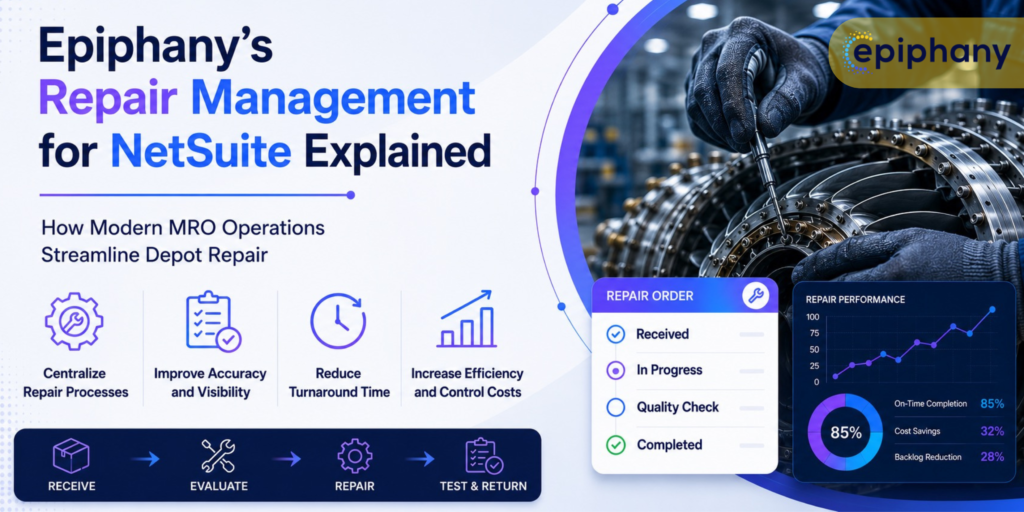
The depot repair lifecycle begins when a customer asset arrives at the service facility. Inside Epiphany’s repair management solution for NetSuite, intake processing is a structured workflow rather than a manual logging task. The asset is received, its condition at arrival is documented, the relevant customer record and contract are pulled automatically, and the initial work order is created from a template that ensures all required steps and documentation fields are captured from the start. Arrival notifications go out to the relevant internal teams and, where appropriate, to the customer, without anyone having to manually send them.
After intake comes diagnosis and work scoping. Technicians inspect the asset, identify what needs to be done, and develop a repair scope that captures the parts required, the labor hours estimated, and any subcontracted work that needs to be arranged. Inside Epiphany’s solution for NetSuite, this scoping process is built directly into the work order record, creating a documented repair plan that can be reviewed and approved through a configured workflow before work begins. For customer jobs where cost control is critical, the approval step ensures that nothing proceeds without the right sign-off, and the customer can be included in that approval loop when the contract requires it.
Work execution is where the depot repair lifecycle is most operationally complex, and where Epiphany’s functionality adds the most value over standard NetSuite. Technicians receive their assignments through the system, log labor against the work order as they work, and record every part consumed against the specific job and the specific asset position where it was installed. If a repair uncovers additional issues that require scope changes, those changes are captured and routed through the appropriate approval process before work continues. Rework, when it occurs, is tracked separately so that its cost impact is visible and attributable rather than buried in the overall job record.
To complete a customer repair successfully, service providers must have complete visibility into where every required part will come from before work can proceed. Depending on the repair and the customer’s service agreement, required components may be sourced from the company’s ERP inventory, customer-owned inventory, repaired from existing stock, recovered from scrapped assets, or purchased as new or serviceable used parts from approved suppliers.
Epiphany’s repair management solution for NetSuite manages these sourcing decisions within the repair workflow while tracking inventory shortages, procurement activities, and every movement of every part throughout the repair lifecycle. By maintaining complete traceability from sourcing through installation, service organizations can minimize repair delays, improve inventory control, and ensure technicians always have the right components available to complete the job efficiently.
Quality inspection follows work execution, with inspectors completing structured inspection checklists directly within Epiphany’s repair management solution for NetSuite and documenting the results against the service work order. For many industries, quality inspection is more than an internal verification process. It is a regulatory requirement that determines whether an asset can be returned to service. In highly regulated industries such as aviation, repairs often require complex approval workflows, documented inspections, and certification records such as the FAA Form 8130, along with complete parts traceability and technician sign offs. Epiphany manages these approval processes and supporting documentation within the repair workflow, helping organizations maintain compliance while reducing manual effort and minimizing the risk of incomplete or missing records. Once all quality requirements have been satisfied, the repair can proceed confidently to return and closeout with a complete and auditable service history.
Return and closeout is the final stage of the depot repair lifecycle. The asset is prepared for return to the customer, and the work order is closed inside Epiphany’s solution for NetSuite. Closeout triggers the billing process, which pulls actual labor hours, parts costs, and any applicable contract pricing from the work order to generate an accurate customer invoice. The complete repair record, including all documentation, parts traceability, inspection results, and labor detail, is stored against the asset’s history inside NetSuite where it can be retrieved for future reference, customer reporting, or regulatory audit.
Closing a repair marks the beginning of the financial analysis for every service work order. Because every labor hour, part, subcontracted service, consumable, and other direct cost has been captured throughout the repair lifecycle, Epiphany provides complete visibility into the true cost and profitability of each repair.
Organizations can compare estimated costs with actual costs, calculate margins at the individual work order level, and identify opportunities to improve pricing, operational efficiency, and resource utilization.
Costs can be categorized according to business requirements, including labor, subcontract labor, parts, consumables, freight, and other expense categories, giving management the detailed financial insight needed to understand repair profitability and make better business decisions based on accurate service work order costing rather than assumptions.
Common Depot Repair Problems That Epiphany Solves Inside NetSuite
Depot repair operations running without Epiphany’s connected solution face a predictable and expensive set of problems. Job status is invisible to anyone not physically on the shop floor, which means customer service teams cannot answer basic questions without interrupting technicians to ask. Parts shortages are discovered mid-repair rather than anticipated during scoping, which delays completion and forces emergency procurement at premium prices. Labor hours are logged on paper or reconstructed at the end of the day, which means job costing is always behind reality. Compliance documentation is assembled manually from multiple sources after the job is complete, which creates errors and omissions that expose service providers to regulatory risk. Invoices are built by a billing team working from incomplete information, which means disputes with customers and revenue leakage are both common.
Epiphany’s repair management solution for NetSuite eliminates each of these problems by connecting the people, the processes, and the data that depot repair requires into a single operational environment. Job status is always current and always accessible. Parts availability is confirmed before commitments are made to customers. Labor is logged in real time against the correct work order. Compliance documentation is captured as part of the repair workflow, not assembled after the fact. And invoicing pulls directly from work order actuals, which means billing is accurate and can be processed the day the job closes.
How Epiphany’s Repair Management for NetSuite Transforms MRO Service Operations
MRO service companies that have implemented Epiphany’s purpose-built functionality for NetSuite describe a consistent set of operational improvements that go beyond what any individual feature delivers in isolation. The transformation comes from having all of the operational data connected in one place, so that decisions at every level of the organization are made with complete, current information rather than incomplete data or no data at all.
Operations managers who previously spent hours each day tracking down job status information and chasing parts availability now have a single dashboard inside Epiphany’s NetSuite solution that shows every open customer job, every overdue task, every parts shortage, and every financial variance from estimate. The time that was spent gathering information is now spent acting on it. Throughput improves because bottlenecks are visible before they become delays. Customer commitments are met more consistently because the system surfaces risks early enough to address them.
Preventive and Future Predictive Maintenance Connected to Depot Repair Through Epiphany
Modern MRO service companies do not just react to customer asset failures. The most competitive providers use preventive and future predictive maintenance programs to help their customers avoid failures entirely, scheduling depot repair work proactively based on usage data, condition monitoring, and contract-defined maintenance intervals rather than waiting for breakdowns to trigger reactive repair demand.
Epiphany’s solution for NetSuite supports both preventive maintenance workflows and connects them directly to the depot repair operation. Preventive maintenance schedules configured inside Epiphany’s NetSuite Service Work Order automatically generate work orders based on calendar intervals, usage hours, or condition triggers tied to individual customer assets and service contracts. Planned work arrives at the depot with known scope and known parts requirements, which makes it dramatically easier to staff and schedule than emergency repair demand. But, if during that planned maintenance it is discovered that repair is needed as well, the Epiphany eService solution will handle the repair, what is or isn’t under warranty and what needs to be billed while still allowing for the tracking of the planned maintenance. The depots that process a high proportion of planned maintenance work operate more efficiently and profitably than those dominated by unplanned repairs, and Epiphany’s NetSuite solution is what makes building that planned maintenance pipeline operationally manageable.
For the future, Epiphany will begin to integrate to IOT software to determine what predictive maintenance may be needed. This will utilize the IOT information to automatically create predictive maintenance work orders to manage equipment needs before it fails.
Technician Management and Labor Optimization Through Epiphany’s NetSuite Solution
Technician time is the most valuable and most perishable resource in a depot repair operation. In a shop where assignments are communicated verbally or on paper, where time is logged manually at the end of a shift, and where no system exists to match technician skills and certifications to job requirements, labor inefficiency and cost overrun are almost guaranteed. Epiphany’s repair management functionality for NetSuite changes that equation fundamentally.
Through Epiphany’s solution, technicians can be assigned to customer work orders based on their documented skills, active certifications, and current workload inside NetSuite. In regulated industries like aviation, where specific repair tasks can only be signed off by technicians holding particular licenses or approvals, this certification-aware assignment capability is a compliance requirement as much as an efficiency tool. Labor hours are logged electronically against the work order as work is performed, keeping job costing current throughout the repair rather than summarized at the end of the week. Overtime, idle time, and utilization rates are visible in real time, giving operations managers the data they need to make staffing decisions based on what is actually happening in the depot rather than what happened last week.
Epiphany continues to invest in expanding its repair management capabilities to further streamline depot operations and improve data accuracy. Future enhancements include full integration with barcode scanning, enabling faster and more accurate tracking of inventory transactions, parts movement, asset identification, and work in progress throughout the repair lifecycle.
Planned automated time entry functionality, powered by internal and external geofencing, will further reduce administrative effort by automatically recording technician time based on location and activity rather than manual entries. Together, these capabilities will help improve operational efficiency, enhance inventory accuracy, and provide even greater visibility into technician productivity and repair performance.
Customer Visibility and Communication Powered by Epiphany
Customers who send their assets to a depot for repair want to know where their asset is and when it will be back. In a service operation without a connected management system, providing that visibility requires constant manual effort from coordinators who are already stretched. Epiphany’s repair management solution for NetSuite automates the customer communication that previously consumed hours of coordinator time every day.
Beyond automated notifications, Epiphany extends customer engagement through a secure self service customer portal that provides real time visibility into the repair process. Customers can submit Return Material Authorization (RMA) requests, track the status of active repairs, review repair progress, and access relevant service documentation without relying on phone calls or email updates.
This level of transparency reduces the administrative burden on customer service teams while giving customers immediate access to the information they need. By empowering customers with self service capabilities and real time repair visibility, MRO service providers can improve communication, strengthen customer relationships, and deliver a more responsive service experience.
Automated notifications can be triggered at every meaningful milestone in the repair lifecycle, when intake is complete, when the repair scope is approved, when work begins, when quality inspection is passed, and when the asset is ready for return. For customers managing large fleets across multiple service vendors, this kind of transparent, real-time communication is increasingly a decisive factor in contract award decisions. The MRO service provider that can show customers exactly where their assets are at any point in the repair process has a significant competitive advantage over one that cannot. Epiphany’s solution for NetSuite is what makes that level of customer transparency operationally achievable without adding headcount to deliver it.
Epiphany’s Depot Repair Solution Across MRO Service Industries
The demand for Epiphany’s purpose-built repair management functionality inside NetSuite is driven by MRO service companies across several industries, each facing their own specific version of the depot repair challenge and their own urgency around modernizing the systems that support it.
Aviation MRO service providers operate under some of the strictest regulatory oversight in any industry. Every repair action on a customer aircraft or aircraft component must be documented with a level of detail and traceability that manual systems cannot reliably produce at scale. Epiphany’s repair management solution for NetSuite gives aviation MRO providers the structured workflows, parts traceability, technician certification management, and compliance documentation capabilities that allow them to meet regulatory requirements while simultaneously improving the operational efficiency and customer transparency that airline customers demand. In 2026, aviation MRO providers still managing these requirements with manual documentation or legacy systems face increasing risk from both regulators and customers.
Oil and gas MRO service providers work with customers for whom unplanned asset downtime carries enormous financial consequences. The pressure to return customer assets to service quickly, correctly, and with complete documentation of what was done is relentless. Epiphany’s solution for NetSuite gives oil and gas MRO service providers the real-time operational visibility, parts traceability, and customer reporting capabilities they need to meet that standard consistently across a high volume of concurrent repair jobs.
Heavy equipment and manufacturing MRO service providers manage high volumes of customer repair jobs across distributed service networks, often with significant variability in repair scope and asset condition at intake. Epiphany’s repair management functionality for NetSuite scales to handle that volume and variability, giving service companies the throughput visibility, parts management, and financial control they need to operate profitably across a large and diverse customer base.
Wrapping Up
Depot repair is where the most complex, highest-stakes MRO service work happens, and it is exactly where disconnected systems cause the most damage to service quality, customer relationships, and financial performance. Epiphany’s purpose-built repair management solution for NetSuite gives MRO service companies the connected, real-time operational environment they need to process customer repairs faster, with greater accuracy, better documentation, clearer customer communication, and tighter financial control than any generic ERP can deliver. NetSuite provides the foundation. Epiphany provides what makes it actually work for depot repair. The MRO service companies winning the best contracts in 2026 are not the ones with the most technicians or the biggest facilities. They are the ones with the clearest visibility into every stage of every customer repair job, and the systems to act on that information before it becomes a problem. If your depot operation is ready to work at that level, Epiphany’s repair management solution for NetSuite is where that journey starts.
Sources
- https://epiphanyinc.net/streamline-repair-operations-with-epiphanys-mro-for-netsuite/
- https://www.netsuite.com/portal/resource/articles/inventory-management/equipment-inventory-management.shtml
- https://suiteworkstech.com/netsuite-repair-preventive-corrective-maintenance/
- https://netsuite.openteqgroup.com/solutions/advanced-mro
- https://www.cebasolutions.com/microverticals/netsuite-for-maintenance-repair-and-operations-mro-services
- https://www.suiteapp.com/RepairSeries-Repair-Management-for-NetSuite
- https://erpsoftwareblog.com/cloud/industry/maintenance-repair-overhaul-mro/
- https://www.erpvar.com/mro-software-maintenance-repair-and-overhaul-erp
- https://netsuite.openteqgroup.com/industry-activations/mro
- https://sourceforge.net/software/maintenance-management/integrates-with-netsuite